
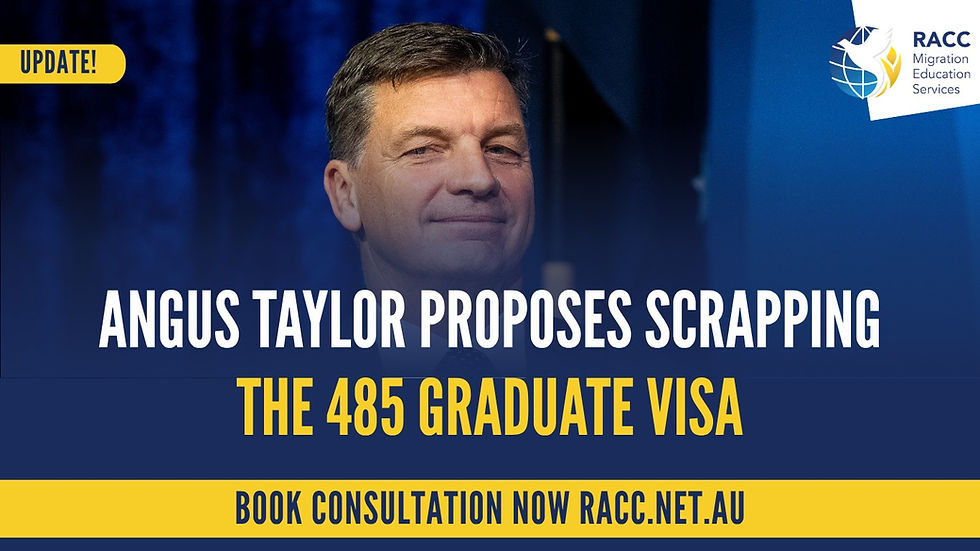
Angus Taylor Proposes Scrapping Most 485 Visas in New Coalition Immigration Policy
Updated Oct 9, 2026
On 6 October 2026, Opposition Leader Angus Taylor released a new Coalition immigration policy for the Liberal and Nationals. It promises to cut net overseas migration to 100,000 a year for two years and reduce the number of temporary visa holders by around 650,000 over four years (Liberal Party of Australia, 6 October 2026).
The plan would abolish the Temporary Graduate visa (subclass 485) for most graduates. Post-study visas would stay only for PhD graduates, health and education students, and students at regional universities.
This is an Opposition election policy. It is not law.
The current 485, Student and skilled visa rules still apply today. Nothing in this plan takes effect unless the Coalition wins the next federal election, which is due in 2028.
Key takeaways
The Coalition's plan is a proposal. No visa law or regulation has changed because of it.
Net overseas migration target: 100,000 in each of the first two years, then 130,000, then 160,000 in year four.
The 485 visa would go for most graduates. PhD, health, education and regional university students would keep a post-study visa.
International student commencements would be cut to 240,000, and most secondary applicants (family members) would be restricted.
Second and later temporary visa applications would have to be made from outside Australia.
The permanent skilled program would stay at 185,000 places a year. Family reunion visas would not change.
Labor's own migration changes are already in effect. Those are the rules that apply to your application right now.
What does the Coalition immigration policy include?
The Coalition describes its plan as the "largest cut to immigration in Australian history". It sets out year-by-year targets for net overseas migration (NOM) in its official media release:
Financial year | Proposed NOM |
2028-29 | 100,000 |
2029-30 | 100,000 |
2030-31 | 130,000 |
2031-32 | 160,000 |
For comparison, NOM was 306,000 in the year to 30 June 2025 (Reuters). The latest figure was 292,100 in the year to March 2026.
NOM is not the same as the number of visas granted. It counts people who stay in Australia for 12 months or more within a 16-month period, minus people who leave on the same basis. Most of the Coalition's cut comes from reducing temporary visa holders, not the permanent program.
The Coalition says the plan cuts "core" temporary visa holders (excluding visitors and New Zealanders) from 1,766,200 in 2025-26 to 1,116,600 by 2031-32.
Which visas would the Coalition immigration policy change?
The figures below come from the Coalition's media release and background tables unless another source is linked.
Temporary Graduate visa (subclass 485)
Abolished for most graduates.
Students completing PhDs, studying health or education, or studying at regional universities would have access to "post-study transitional visas".
Temporary Graduate visa holders would fall from 271,200 (2025-26) to 10,000 (2031-32).
The plan does not explain how the replacement post-study visa would work. It gives no detail on length of stay, work rights, or how current 485 holders and applicants would be treated.
Student visa (subclass 500)
International student commencements cut to 240,000.
Student visa holders reduced from 528,800 (2025-26) to 456,200 (2031-32).
Most secondary applicants restricted. Labor has already restricted family members on new Student visas.
Together with abolishing the 485, the Coalition expects these changes to bring the share of overseas students in higher education below 25%.
Each Student visa linked to the enrolling institution.
Home Affairs tasked with targeting students who work beyond their permitted hours, for example through gig economy work or an ABN.
Applying onshore and bridging visas
Second and later temporary visa applications would have to be made offshore.
Second- and third-year Working Holiday Makers could still reapply onshore.
The Coalition says this would "virtually eliminate" bridging visas. Bridging and temporary protection visa holders would fall from 414,700 to 20,000. See how a bridging visa works after a 485 application under current rules.
Onshore protection visa applicants would have to apply within 30 days.
Merits review would be removed for adverse character decisions, temporary visa refusals and offshore applicants. Most visa refusal reviews currently go to the Administrative Review Tribunal (ART).
Skilled and employer-sponsored visas
Permanent skilled program kept at 185,000 places a year.
Priority for applicants who meet criteria on income, age, English and full-time work, plus skilled partners.
Specialist Skills stream of the Skills in Demand visa opened up to bring in up to 5,000 more highly skilled workers a year.
New Skilled Project Visa: 15,000 places a year, tied to a defined major project and period.
Temporary skilled priority list revised.
A strike force to clear the backlog of skilled construction applications.
Talent and Innovation allocation doubled to 7,000 places through a new AUKUS and Five Eyes visa.
The regional permanent program replaced with Ministerial Directions that prioritise employer-sponsored applications in regional Australia.
Temporary skilled visa holders would rise from 260,600 to 321,000 under the forecasts.
Working Holiday Maker visas
Labor's ballot and caps for second- and third-year visas reversed.
Visa fees raised for Working Holiday Makers, with an exemption for those in regional areas.
Regional definitions for extension requirements revised.
Working Holiday Maker visa holders forecast to fall from 225,600 to 202,000.
A new Agriculture Visa from 2030.
Humanitarian and family visas
Humanitarian intake halved to 10,000 places a year.
No changes to family reunion visas.
Housing cap and values-based rules
Under the Coalition's Migration and Housing Pledge, migration would stay below the number of homes built each year. The permanent program cap could be cut further to meet it.
An earlier part of the plan would make compliance with the Australian Values Statement a condition on every visa (Liberal Party of Australia).
The same earlier plan proposes a Safe Country List to fast-track the refusal of unfounded protection claims. It would also restore Temporary Protection and Safe Haven Enterprise visas for people who arrive unlawfully.
Is the 485 visa being abolished now?
No. The Temporary Graduate visa (subclass 485) remains open under its current criteria.
If you meet the requirements today, you can apply today. A political proposal does not change migration law.
Timing still matters. The Coalition says many of its major changes, including the 485 changes, could be made quickly using existing ministerial powers. If it wins government, changes could follow soon after the election rather than through a long legislative process.
That is a reason to plan early. It is not a reason to panic.
For the current eligibility rules, streams and fees, see our Temporary Graduate visa (subclass 485) guide.
How does the Coalition immigration policy compare with Labor and One Nation?
All three major political forces now propose lower migration. Only Labor's settings are in force.
Labor (government) | Coalition (Opposition) | One Nation | |
Status | Being implemented now | Election proposal | Election proposal |
NOM target | 245,000 (2026-27), 225,000 (2027-28) | 100,000 for two years, rising to 160,000 | Net negative at first, then capped at 130,000 |
Temporary visa cut | Through rule changes | Around 650,000 over four years | More than 750,000 over three years |
Students and graduates | Most new students cannot bring family members | 485 abolished for most; 240,000 student commencements | Student visa grants cut from more than 290,000 to 115,000 a year |
Labor's Student visa reform took effect on 2 October 2026. Most new Student visa applicants can no longer include family members, with exemptions for some groups. Read the new Student visa rules for what changed.
How have business, universities and Labor responded?
Reaction has split along familiar lines.
The Coalition estimates a small positive budget impact of around $260 million over four years. It argues Temporary Graduate visa holders pay, on average, less than one-third of the tax of a skilled visa holder (Liberal Party).
Costing: the Parliamentary Budget Office did not formally cost the policy. The Coalition says full costings will come closer to the election (ABC News).
Labor frontbencher Matt Keogh warned the cuts would badly damage the economy and services (The Guardian).
Business: the Australian Chamber of Commerce and Industry warned the scale of the cuts would hurt the economy. Master Builders Australia welcomed the skilled migration focus but has not settled its view on the rest.
Universities: the Group of Eight called for careful examination. It noted higher education visa applications are already down 9% on last year and grants down 17% (The PIE News). Universities Australia warned the plan risks lasting damage to the sector (Times Higher Education).
Aged care: the sector also raised concerns about workforce supply (ABC News).
What should students and visa holders do now?
The practical steps depend on where you are in your visa journey.
If you are finishing a course in Australia
Check your 485 eligibility now, including the age, English and application timing requirements on the Home Affairs 485 page.
If you are eligible and ready, waiting for a policy that does not exist yet gains you nothing.
Map your next step after the 485 too. Skilled, employer-sponsored and state-nominated visas each have their own criteria. Our PR points calculator gives you a starting point.
If you are planning to study in Australia
Choose a course for your career, not for a visa outcome. Proposed exemptions for health, education, PhD and regional study are not guaranteed.
Plan around the rules in force now. Since 2 October 2026, most new Student visa applicants cannot bring family members.
Read our guide on how to choose a course in Australia, or compare courses linked to in-demand occupations.
If you hold another temporary visa
Know your visa expiry date and your next visa option well before that date. Start with the visas you can apply for after a Student visa.
Avoid relying on onshore applications and bridging visas as a long-term plan. Both Labor's recent changes and the Coalition's proposal move away from them.
If you are an employer or skilled worker
Skilled and employer-sponsored migration stays in both the government's and the Coalition's plans.
See our employer-sponsored visa options and the regional Subclass 494 visa for current pathways.
For everyone
Treat social media claims such as "the 485 is cancelled" with care. Check immi.homeaffairs.gov.au for rule changes.
Get advice from a registered migration agent before you make a decision based on a proposal.
Frequently asked questions
Has the 485 visa been cancelled?
No. The Temporary Graduate visa (subclass 485) is still open. The Coalition's plan to abolish it for most graduates is an election proposal. It would only take effect if the Coalition wins government and then changes the rules.
When would the Coalition immigration policy start?
Only after the Coalition wins a federal election. The next election is due in 2028, and the plan's migration targets begin in 2028-29. The Coalition says many changes could then be made quickly through existing ministerial powers.
What would happen to people who already hold a 485 visa?
The plan does not say. No transitional arrangements have been published for current 485 holders or people with applications in progress.
Which graduates would keep a post-study visa under the plan?
Students completing PhDs, students studying health or education, and students at regional universities. The plan calls these "post-study transitional visas" but gives no detail on how they would work.
Can international students still bring family members to Australia?
Under Labor's rules in force since 2 October 2026, most new Student visa applicants cannot include family members, with some exemptions. The Coalition's plan would also restrict most secondary applicants.
Does the Coalition plan change partner or parent visas?
The Coalition says there will be no changes to family reunion visas. Its release does not list which visas that covers, so check how partner visas work today and watch for more detail. Separately, the plan gives priority to skilled partners within the permanent skilled program.
Talk to a registered migration agent
Policy announcements move fast. The Coalition immigration policy may change before the election, and so may Labor's and One Nation's. Your visa options depend on your course, occupation, age and visa history.
RACC's registered migration agents (MARN 1572961 and MARN 1172003) and education consultants can review your situation and help you plan your next visa. Book a consultation.
This article provides general information about a political proposal as at 9 October 2026. It is not legal advice. Migration law and policy can change.


Comments